
What Is the Difference Between AI and ML?
In the rapidly evolving landscape of modern technology, terms like “Artificial Intelligence” and “Machine Learning” are often used interchangeably. However, for businesses, developers, and tech enthusiasts, understanding the nuance is critical. While they are inextricably linked, they represent different scopes of computing power.
If you have ever wondered, “what is the difference between ai and ml?” you are not alone. Simply put: AI is the overarching vision of creating machines capable of mimicking human intelligence, while ML is the primary method we use today to achieve that vision.
What Is Artificial Intelligence (AI)?
Artificial Intelligence is a broad field of computer science focused on building smart machines capable of performing tasks that typically require human intelligence. This includes reasoning, problem-solving, understanding natural language, and perceiving visual information.
AI is not a single technology but an umbrella term. It encompasses everything from “Good Old-Fashioned AI” (symbolic AI based on hard-coded rules) to the most advanced generative models like GPT-4.
Types of AI
To understand AI’s scope, we generally categorize it into two types:
- Narrow AI (Weak AI): Designed for a specific task (e.g., facial recognition or a chess program). This is the only type of AI that currently exists.
- General AI (Strong AI): A theoretical form of AI that could perform any intellectual task a human can.
What Is Machine Learning (ML)?
Machine Learning is a subset of AI. It refers specifically to the process by which computers “learn” from data rather than being explicitly programmed with every rule.
Instead of a programmer writing a code that says “if X happens, do Y,” an ML model is fed vast amounts of data and uses statistical techniques to identify patterns. The model then uses these patterns to make predictions or decisions about new, unseen data.
According to IBM’s definition of Machine Learning, the focus is on the use of data and algorithms to imitate the way that humans learn, gradually improving its accuracy over time.
The Core Difference Between AI and ML Explained Simply
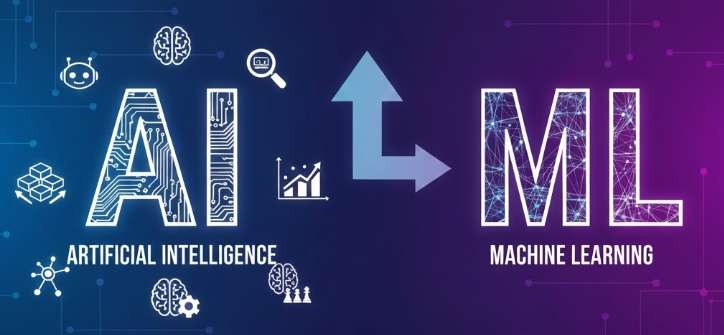
When asking “what is the difference between ai and ml,” the easiest way to visualize it is through the lens of “The Goal” vs. “The Method.”
- The Goal (AI): The objective is to create a system that can simulate human intelligence to solve complex problems.
- The Method (ML): This is one of the ways we train that system. It involves using algorithms to parse data, learn from it, and then make a determination or prediction.
In short, AI is the destination, and ML is one of the most effective vehicles used to get there.
The Rule-Based Distinction
In the early days of AI, systems were “rule-based.” A medical diagnosis AI might have had 10,000 “If-Then” statements programmed by doctors. That is AI, but it is not Machine Learning because the machine isn’t learning anything new; it’s just following a map. ML, conversely, would look at 10,000 past patient records and “figure out” the symptoms itself.
AI vs ML: Side-by-Side Comparison Table
To clarify the technical distinctions, the following table breaks down the primary differences.
| Feature | Artificial Intelligence (AI) | Machine Learning (ML) |
| Definition | The broad concept of machines acting “smart.” | A specific subset of AI that learns from data. |
| Scope | Includes ML, Deep Learning, Robotics, and Expert Systems. | Limited to the study of algorithms and statistical models. |
| Objective | To simulate human intelligence and behavior. | To maximize the accuracy of patterns and predictions. |
| Function | AI aims to solve complex tasks through various means. | ML focuses on performing a specific task based on data. |
| Data Requirement | Can function on logic/rules alone (e.g., Symbolic AI). | Requires large volumes of data to be effective. |
| Output | Intellectual labor (Decision-making, reasoning). | Knowledge/Patterns (Predictions, classifications). |
How Machine Learning Fits Inside Artificial Intelligence
A common point of confusion when discussing what is the difference between ai and ml is where one ends and the other begins.
Think of it as a set of Russian Nesting Dolls:
- Artificial Intelligence is the largest doll.
- Machine Learning sits inside AI.
- Deep Learning (a further specialized subset of ML using neural networks) sits inside ML.
Most of the “AI” we interact with today is actually “ML.” When you see a Netflix recommendation or use a voice assistant, you are interacting with Machine Learning algorithms operating within an Artificial Intelligence framework.
Real-World Examples of AI (Beyond Machine Learning)
While ML is the most popular form of AI today, there are other forms of AI that do not necessarily rely on learning from data in the “learning” sense.
- Rule-Based Expert Systems: Used in manufacturing and accounting to follow complex logic trees.
- Pathfinding Algorithms: Used in video game NPCs (Non-Player Characters) to navigate a map. They don’t “learn” the map; they use pre-defined math to find the shortest route.
- Robotic Process Automation (RPA): Software robots that handle repetitive tasks by following a strict script.
- Conversational Reasoning Systems: Beyond simple automation, modern AI can now engage in complex multi-step reasoning. This is best seen in the latest generation of conversational tools. For instance, while a standard bot might follow a script, advanced AI Chatbots use Large Language Models (LLMs) to understand intent and provide human-like advice across various industries.
These examples illustrate that you can have AI without ML, though these systems are often less “flexible” than their ML-driven counterparts.
Real-World Examples of Machine Learning in Action
Most modern breakthroughs that people call “AI” are actually breakthroughs in Machine Learning. According to research published by MIT Sloan, ML is now the driving force behind the most significant economic disruptions.
- Predictive Maintenance: In factories, ML models analyze sensor data from machines to predict when a part will fail before it actually happens.
- Fraud Detection: Banks use ML to monitor millions of transactions. The system learns what “normal” spending looks like and flags anything that deviates from that pattern.
- Medical Imaging: ML algorithms are trained on millions of X-rays to identify tumors with a higher accuracy rate than some human radiologists.
- Natural Language Processing (NLP): Modern translation tools (like Google Translate) use ML to understand context rather than just translating word-for-word.
Final Thoughts
Understanding what is the difference between ai and ml is more than just a semantic exercise. It helps us understand the limitations and potential of the technology we use every day.
- AI is the umbrella of “intelligent” technology.
- ML is the data-driven engine that makes modern AI possible.
As we move toward a future of increasingly autonomous systems, the line between these two will continue to blur, but the fundamental distinction remains: AI is the “What,” and ML is the “How.”
Whether you are a business leader looking to implement these technologies or a student entering the field, remember that while all Machine Learning is Artificial Intelligence, not all Artificial Intelligence is Machine Learning.

 English