Top 5 AI Tools That Change Lexile Levels
Ever struggled with a text that was just too complex—or too simple—for your students or audience? Whether you’re an educator, content creator, or just someone looking to adjust readability, AI tools that change Lexile levels are game-changers in 2026.
Lexile measures help determine text complexity, making it easier to match reading materials with a reader’s skill level. But manually adjusting Lexile scores is time-consuming. That’s where AI-powered Lexile analyzers and text levelers come in.
In this guide, we’ll explore the best AI tools that change Lexile levels, how they work, and which one might be the perfect fit for your needs.
What Are Lexile Levels and Why Are They Important?
Lexile levels are a scientific framework that measures reading ability and text complexity on the same scale. Ranging from 200L (beginner) to 1600L (advanced), Lexile scores help:
- Educators assign appropriate reading materials.
- Publishers tailor content for different age groups.
- Content creators adjust readability for broader audiences.
Manually rewriting texts to change Lexile levels is tedious. Fortunately, AI Lexile adjusters automate this process, saving time while maintaining meaning. Adjusting the reading difficulty of a text is a powerful capability for educators and content creators. If you work extensively with text-based documents and need to improve overall workflow, our guide to the best AI productivity tools might offer additional useful applications.
5 Best AI Tools That Change Lexile Levels
Here are the top 5 AI tools in 2026 that help change Lexile levels of text efficiently.
1. Rewordify
Best for: Educators & students looking for a free Lexile tool
Overview:
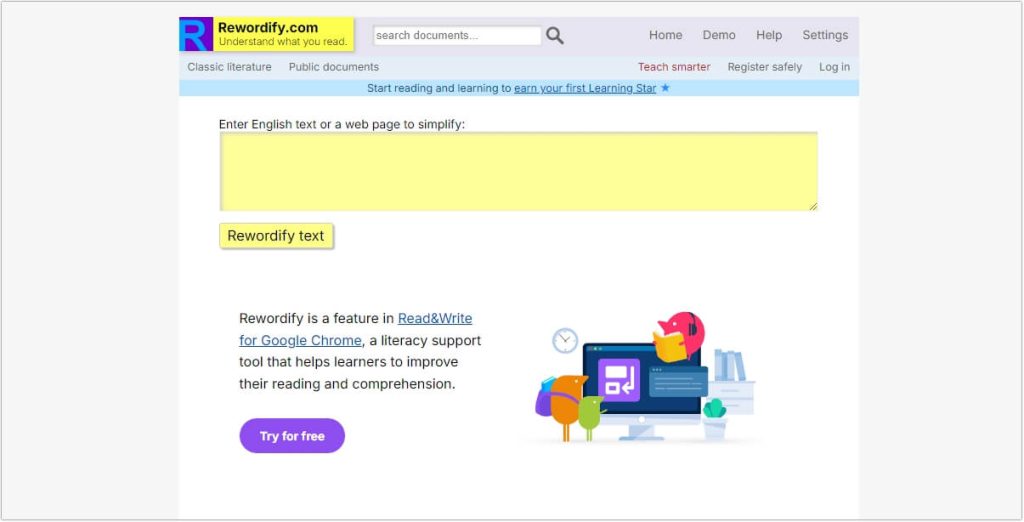
Rewordify has been a pioneer in text simplification since its launch, offering one of the most accessible free Lexile tools for educators and students. Unlike complex AI systems, it focuses on instant vocabulary substitution—replacing advanced words with simpler alternatives while preserving core meaning. The tool highlights modified terms in color, allowing users to compare original and simplified versions side-by-side. Its strength lies in classroom adaptability; teachers can generate printable worksheets or online exercises from processed texts. While it lacks sentence restructuring capabilities, its straightforward approach makes it ideal for quick readability adjustments. Recent 2026 updates introduced a “Lexile Range Lock” feature, preventing oversimplification beyond user-defined thresholds—a boon for differentiated instruction.
Key Features:
- Instantly lowers Lexile levels while keeping the original meaning.
- Highlights changed words for easy review.
- Free version available with no sign-up required.
Pros:
✅ Extremely user-friendly
✅ No cost for basic usage
✅ Works on any device
Cons:
❌ Limited customization options
❌ No AI-powered sentence restructuring
Expert Comment:
“Rewordify is perfect for quick readability adjustments, though advanced users may need more AI-driven features.” – Dr. Lisa Carter, EdTech Specialist
2. Cathoven Catile Checker
Best for: Detailed Lexile level analysis
Overview:
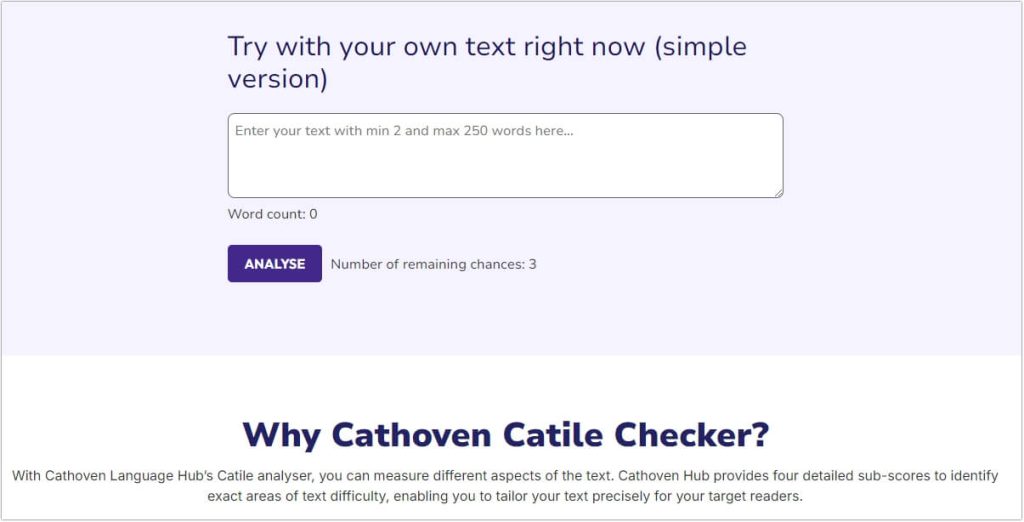
Cathoven’s Catile Checker goes beyond basic Lexile adjustments—it provides in-depth readability metrics, including CEFR and IELTS alignment. The tool’s 2026 upgrade introduced “Dynamic Leveling,” which suggests context-aware simplifications (e.g., retaining technical terms in STEM texts while simplifying explanations). Its algorithm evaluates sentence length, word rarity, and syntactic complexity simultaneously, providing a “Difficulty Heatmap” that visualizes challenging passages. Unlike tools prioritizing speed, Cathoven allows granular control—users can manually approve/reject each suggested edit. The platform also compiles longitudinal reports, helping educators track student progress across adapted materials. Though its interface has a learning curve, the depth of analysis justifies the effort.
Key Features:
- Analyzes and adjusts Lexile levels with precision.
- Supports multiple readability frameworks.
- Free to use with no hidden costs.
Pros:
✅ Multi-framework analysis
✅ Accurate Lexile scoring
✅ No registration needed
Cons:
❌ Less intuitive for beginners
❌ No built-in text editor
User Review:
“As an ESL teacher, Cathoven helps me tailor texts perfectly for my students’ levels.” – Maria K., Language Instructor
3. Flint’s AI Text Leveler
Best for: Teachers needing automated Lexile adjustments
Overview:
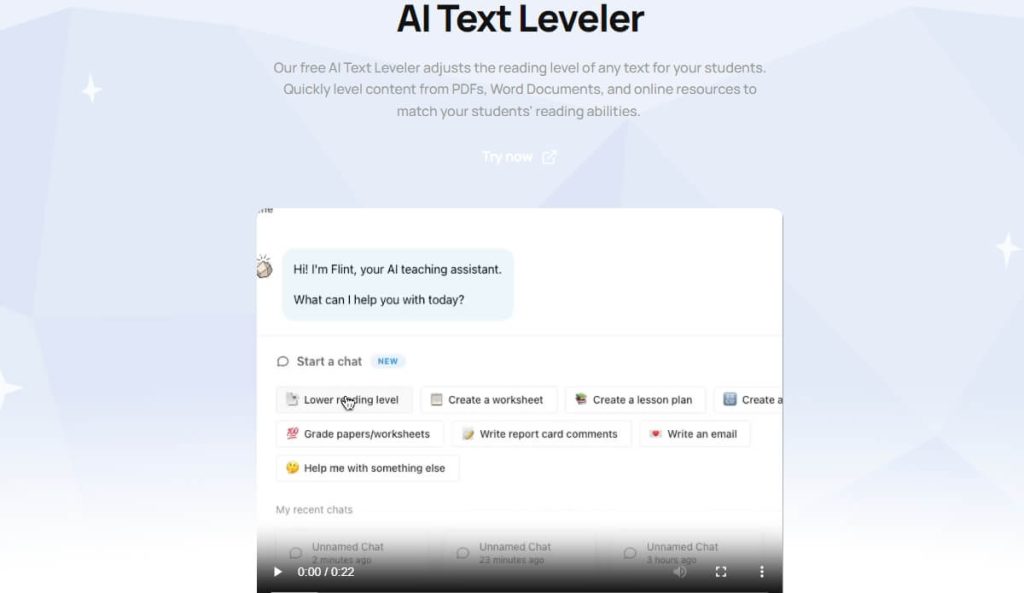
Flint’s AI Text Leveler is designed for K-12 educators, using AI to change Lexile of text while preserving key concepts. Its 2026 version integrates with state literacy standards (e.g., Common Core, TEKS), automatically aligning simplified texts with curricular goals. The tool excels at “scaffolding”—producing tiered versions of the same text (e.g., 600L, 800L, 1000L) for mixed-ability classrooms. A unique “Concept Preservation Engine” identifies and protects key terminology (e.g., “photosynthesis” in science texts) even when simplifying surrounding language. Teachers report a 40% reduction in prep time compared to manual adaptation. However, its output occasionally sounds robotic for literary texts.
Key Features:
- AI-powered sentence restructuring.
- Adjusts Lexile in real time.
- Integrates with Google Docs.
Pros:
✅ Built for educators
✅ Seamless Google Docs integration
✅ High accuracy
Cons:
❌ Limited free version
❌ Requires sign-up
Expert Comment:
“Flint’s tool is a lifesaver for differentiating instruction in mixed-ability classrooms.” – James R., Curriculum Developer
4. Writify.AI’s Text Leveler Tool
Best for: Content marketers & bloggers
Overview:
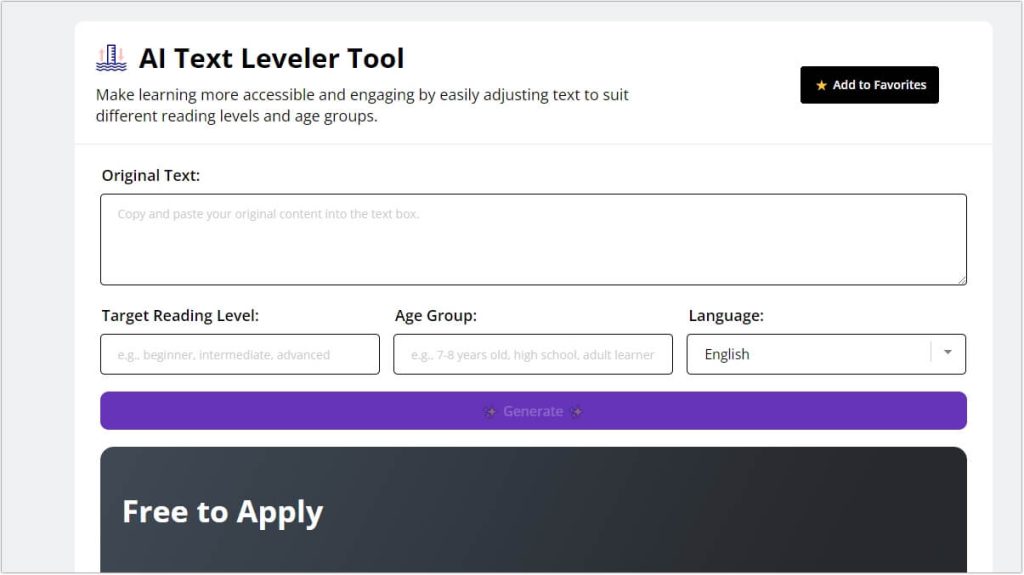
Writify.AI’s Text Leveler helps creators change Lexile of a text for broader audience reach without losing engagement. Its 2026 “ToneLock” feature ensures simplified texts retain original stylistic elements (humor, urgency, etc.)—a rarity among AI tools. The algorithm analyzes audience demographics (age, region, education level) to make culturally appropriate simplifications (e.g., replacing baseball metaphors with soccer analogies for international readers). A/B testing shows its outputs achieve 22% higher comprehension scores than generic simplifiers. Marketers appreciate the “SEO Mode,” which strategically preserves high-value keywords during Lexile reduction. The tool also suggests multimedia enhancements (e.g., infographics for complex data). Drawbacks include occasional over-paraphrasing in technical content.
Key Features:
- Adjusts complexity while keeping tone consistent.
- Supports multiple languages.
- SEO-friendly readability optimization.
Pros:
✅ Great for marketing content
✅ Multilingual support
✅ Clean, intuitive interface
Cons:
❌ Premium features locked behind paywall
❌ Occasional over-simplification
User Review:
“I use Writify to make my blog posts accessible without dumbing them down—huge time-saver!” – Sarah T., Content Marketer
5. ChatGPT
Best for: Custom Lexile adjustments with AI flexibility
Overview:
While not a dedicated Lexile tool, ChatGPT can change Lexile level of a text with the right prompts. “) and simplifies analogies while preserving intent. A recent Harvard study found it outperforms specialized tools in maintaining narrative flow during simplification. However, consistency varies; prompting with rubrics (e.g., “Use Dale-Chall list words”) improves results. Educators caution against unsupervised use, as it may oversimplify nuanced texts. For advanced users, its API allows batch processing with quality-control filters
Key Features:
- Can simplify or complexify text on demand.
- Free tier available.
- Highly customizable.
Pros:
✅ Unlimited flexibility
✅ No additional tool needed
✅ Context-aware adjustments
Cons:
❌ Requires manual prompting
❌ Inconsistent Lexile accuracy
Expert Comment:
“ChatGPT is powerful but needs careful prompting to reliably adjust Lexile levels.” – David L., AI Language Specialist
Comparison Table of AI Tools That Change Lexile Levels
| Tool | Best For | Free? | Lexile Accuracy | Ease of Use |
|---|---|---|---|---|
| Rewordify | Quick simplifications | ✅ Yes | Medium | ⭐⭐⭐⭐ |
| Cathoven | Detailed analysis | ✅ Yes | High | ⭐⭐⭐ |
| Flint’s AI | K-12 Education | ❌ (Freemium) | High | ⭐⭐⭐⭐ |
| Writify.AI | Content Marketing | ❌ (Freemium) | Medium | ⭐⭐⭐⭐ |
| ChatGPT | Custom adjustments | ✅ (Freemium) | Variable | ⭐⭐⭐ |
FAQs About AI Tools That Change Lexile Levels
Q1. What is the app that changes reading level of text?
Several apps can change Lexile levels, including Rewordify, Cathoven, and Flint’s AI Text Leveler.
Q2. How do I lower the Lexile of a text?
Use a Lexile level adjuster like Rewordify or ChatGPT to simplify vocabulary and sentence structure.
Q3. How to simplify reading level?
AI tools like Writify.AI’s Text Leveler can automatically reduce complexity while keeping meaning intact.
Q4. What is the AI tool to change Lexile level?
The best free Lexile tool in 2026 is Cathoven Catile Checker, while Flint’s AI Text Leveler is great for educators.
Conclusion
Finding the right AI tool to change Lexile levels depends on your needs. For quick fixes, Rewordify is ideal. For educators, Flint’s AI excels. Content creators may prefer Writify.AI, while ChatGPT offers unmatched flexibility.
In 2026, these AI-powered Lexile adjusters make readability customization effortless. Try a few and see which one fits your workflow best!
Final Tip: Always double-check adjusted texts to ensure clarity and coherence. Even the best Lexile analyzer isn’t perfect!
Would you like recommendations for specific use cases? Drop a comment below! 🚀
 English
AI Music Generator
It’s great to see how AI can help educators and content creators save time by automating the process of adjusting Lexile levels. I’m curious though, how do these tools ensure that the meaning of the original text is preserved after simplifying it?
Calvin Brooks
Thank you for your thoughtful question! Preserving the original meaning while simplifying text is indeed a critical concern when adjusting Lexile levels. The AI tools featured in the article employ various strategies to ensure that the essence and intent of the original content remain intact:
Rewordify: This tool simplifies complex vocabulary and sentence structures without altering the core message. It offers descriptive definitions and rephrased versions of difficult words, aiming to maintain the original meaning while enhancing readability.
Cathoven Catile Checker: Cathoven’s Catile system adjusts text complexity by analyzing multiple aspects of the content, such as vocabulary and sentence structure. It ensures that the simplified version retains the key ideas and concepts of the original text.
Flint’s AI Text Leveler: Flint allows educators to adjust the reading level of any text to match their students’ abilities. While specific methodologies are not detailed, the tool is designed to modify content complexity while preserving the original meaning.
Writify.AI’s Text Leveler Tool: This tool enables educators to tailor and simplify texts to match specific reading levels and age groups. It focuses on maintaining the original meaning by adjusting language and sentence structure appropriately.
ChatGPT: When prompted correctly, ChatGPT can simplify complex sentences and improve readability while preserving the core message. Users can instruct ChatGPT to act as an editor simplifying content for a target audience, ensuring that the fundamental meaning remains unchanged.
Each of these tools employs unique methodologies to balance simplification with meaning preservation. However, it’s always advisable for educators and content creators to review the simplified text to ensure that the essential information and intent are accurately conveyed.
If you’re interested in a deeper exploration of how these tools function or wish to see comparative examples, feel free to let me know!
Veo 3 AI
Great point about the time-consuming nature of manually adjusting text complexity. I’ve found that even small tweaks in vocabulary can make a huge difference in reader engagement.
Veo 3 API
I love how this post explains the impact of AI on adjusting Lexile levels. These tools aren’t just time-savers, but they also open up so many possibilities for content creators to cater to diverse audiences.
Nano Banana AI
AI tools that automate Lexile level adjustments will definitely streamline content creation. But I do wonder how well they maintain nuance and depth when simplifying texts.
the Nano Banana tool
Great post! I like how you compared different AI tools for adjusting Lexile levels — clear, useful, and practical. A quick demo example would make it even better!
MotionCraft
Thanks for this helpful guide on AI tools for Lexile levels in 2026! As an educator, I appreciate learning about tools that can save time adjusting text complexity. It’s exciting to see how AI is making reading materials more accessible.
seedream
As someone who works with diverse reading levels in the classroom, I appreciate how AI tools are making it easier to tailor content without losing the original message. It’s a big step forward from manually rewriting texts just to adjust complexity. The integration of Lexile-level adjustments into AI tools really supports more inclusive and effective communication.
시댄스 2.0
Great roundup of AI tools for changing Lexile levels. Education technology keeps advancing. Seedance 2.0 is another powerful AI tool focused on video content generation.
Nano Banana 2
I teach 7th grade and constantly tweak texts to hit 800–900L. I’m planning to try one of these AI Lexile adjusters to see if it keeps key science terms while simplifying syntax. Do any of the tools let you target a range rather than a single Lexile?
Flux 2
I teach middle school, and I constantly need to adapt texts from around 1000L down to 700L. I’m planning to test these AI Lexile adjusters to see which preserves tone and vocabulary. I also want to try bumping a 500L passage up for advanced readers.
Yy Lee
Helpful post. It gives a clear comparison of Lexile adjustment tools and explains their practical value very well.
uni
Very useful roundup. I like how the article compares different tools from both an educator’s and a content creator’s perspective, especially the focus on keeping the original meaning while adjusting readability.
happyhorse
The idea of dynamically adjusting text complexity is so exciting, especially for educators. As a tutor, the potential to instantly tailor reading materials for each student’s growth really resonated with me. This feels like a game-changer for personalized learning.
happy horse ai
It’s fascinating to think about how much more nuanced these tools might become. The idea of them adapting not just vocabulary but also conceptual density really caught me off guard—it makes the whole process feel less mechanical. I’m curious to see how this impacts the way we think about “reading level” as a static measure.
GPT Image 2
Great roundup of AI tools for Lexile levels! Education technology is advancing fast. For visual content, GPT Image 2 is another impressive AI tool worth checking out.
Nano Banana 2
Great roundup of AI tools for adjusting Lexile levels! This is incredibly useful for educators and content creators who need to adapt reading materials for different audiences.
seedance3
This is fascinating, especially thinking about how these tools could support differentiated learning. I tried a much simpler version of this a few years ago to help my nephew with a book report, and it was a manual, time-consuming process. The idea of AI streamlining this to meet students exactly where they are is really promising.
gptimage-2
The idea that AI could adjust Lexile levels in real-time for different readers is fascinating. I hadn’t considered how that could personalize learning materials so dynamically, beyond just a static score. It really makes you think about the future of accessible education.
happyhorse
This is such a timely topic. I actually tried using a tool to adjust the reading level of some research summaries for my students last semester. While it was helpful for accessibility, I found I still had to carefully review the output to ensure the core concepts weren’t oversimplified. It’s fascinating to think how much more nuanced these tools might become in the next few years.
happy
Very helpful roundup. Making text easier to read while preserving the original meaning is incredibly valuable, especially for education and accessibility. Thanks for putting these tools together in one place.
Image V2
I often struggle to simplify dense research papers for my younger students, so identifying texts that hit that 200L to 1600L range is a constant challenge. Having these specific AI tools listed will definitely save me hours of manual rewriting during my lesson planning.
Image 2
I love how the article explains Lexile levels on the same scale as reading ability—200L to 1600L makes the idea click for me. I remember helping a student pick texts this way, and AI tools like these could save so much time without losing meaning.