Top 5 Must-try AI Document Summarizer
In the relentless data stream of the modern professional world, information overload is a genuine challenge. Professionals, academics, and students alike are buried under mountains of lengthy reports, complex research papers, and dense business documents. The ability to quickly distill key insights is no longer a luxury; it’s a necessity for efficiency and informed decision-making. This is where the power of an ai document summarizer becomes indispensable.
These sophisticated tools leverage advanced Natural Language Processing (NLP) and machine learning to analyze text, identify core themes, and generate concise, coherent summaries. Whether you need to grasp the essence of a 100-page contract in minutes or summarize a collection of academic articles for a literature review, a reliable document summarizer ai can save you hours of manual labor. This article provides an authoritative, in-depth review of the top 5 must-try AI summarization tools in 2026, guiding you to the perfect solution for your needs, including excellent options for a free ai document summarizer.
How We Evaluated These AI Summarization Tools
To ensure this review is both credible and practically useful, we established a rigorous evaluation framework. Our testing methodology was designed to assess each tool’s performance in real-world scenarios. We analyzed a standardized set of documents—including a complex academic PDF, a multi-page business report, and a legal contract—across several key dimensions:
- Accuracy & Coherence: Does the summary accurately reflect the source document’s main arguments and facts without introducing hallucinations or errors?
- Ease of Use & Interface: How intuitive is the user experience? Is the tool accessible for non-technical users?
- Supported Formats & Integration: What range of document formats does it support (PDF, DOCX, TXT, etc.)? Are there any browser extensions or API access?
- Feature Set: Beyond basic summarization, what additional features are offered (e.g., citation generation, key point extraction, multilingual support)?
- Value for Money: Is the pricing model transparent? Does the free plan, if available, offer substantial value?
This meticulous approach ensures our recommendations are trustworthy and based on hands-on, expert analysis.
The Best 5 AI Document Summarizer
Here is our curated list of the top 5 AI tools that excel at helping you ai summarize documents effectively.
1. Decopy AI Document Summarizer
Brief Introduction: Decopy positions itself as a modern, user-centric tool designed for professionals who need quick and accurate document digestion. It emphasizes a clean, distraction-free interface that gets the job done without unnecessary complexity.
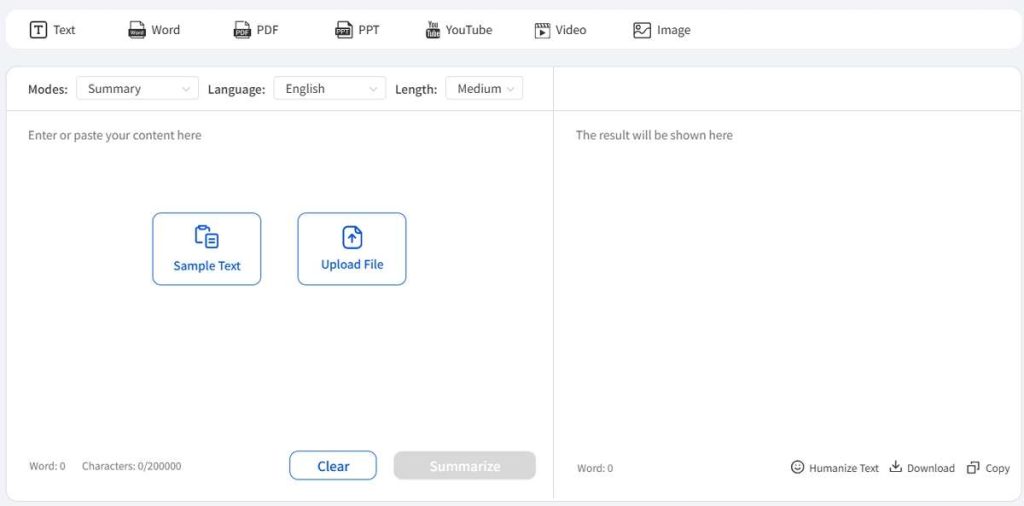
Supported Formats: PDF, DOCX, PPTX, and TXT files. It also offers a convenient browser extension for summarizing online articles directly.
Key Features:
- Multiple summary formats (bullet points, paragraph, and key sentences)
- Adjustable summary length slider for customizability
- Integrated “Explain” feature for clarifying complex sentences within the text
- Secure, encrypted processing with a clear data privacy policy
Pros & Cons:
Pros: Extremely fast processing; highly intuitive interface; robust free tier.
Cons: Lacks some of the advanced analytics features found in more research-oriented competitors.
Expert Comment: “Decopy strikes an impressive balance between speed and accuracy. Its browser extension is a game-changer for researchers, allowing them to summarize web-based content without ever leaving their browser tab. It’s one of the most straightforward tools to ai summarize documents for daily use.“
2. NoteGPT AI Document Summarizer
Brief Introduction: NoteGPT is more than just a summarizer; it’s a comprehensive knowledge management platform. It is particularly popular among students and academics for its ability to handle not just documents but also video and audio content, making it a versatile research companion. It is one of the well-known AI Book/Textbook Summarizers
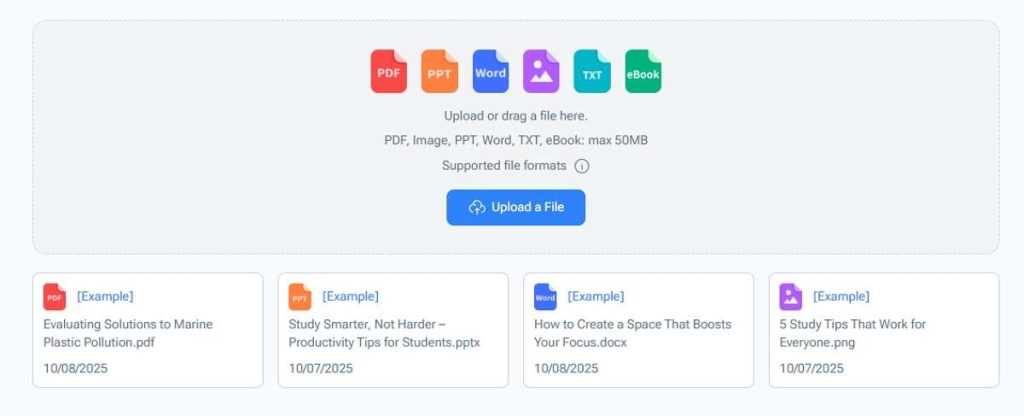
Supported Formats: PDF, DOCX, TXT, and notably, YouTube videos and audio files (via transcription).
Key Features:
- AI-powered summary for both documents and videos
- Automatic generation of timestamps for video summaries
- Built-in note-taking system that links directly to the summarized source
- “Q&A with Document” feature to interact with the content
Pros & Cons:
Pros: Unique multi-format support (text, video, audio); excellent for academic research; integrated note-taking ecosystem.
Cons: The interface can feel slightly cluttered compared to minimalist tools; video processing can take longer.
User Comment: “As a PhD student, NoteGPT has revolutionized my workflow. I can summarize a stack of PDFs and key lecture videos in one place, and the linked notes ensure I never lose the context of my summaries. It’s the ultimate document summarizer ai for heavy-duty research.“
3. Noiz’s AI Document Summarizer
Brief Introduction: Noiz offers a powerful and completely free ai document summarizer as part of its suite of online AI tools. It is designed for users who need a no-strings-attached, high-quality summarization solution without signing up for an account or entering credit card details.
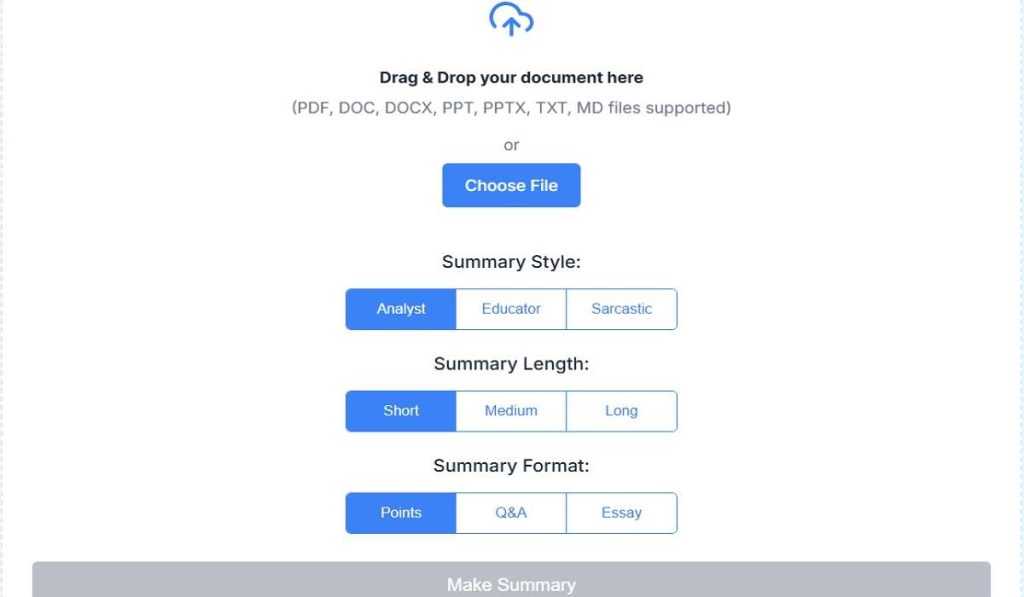
Supported Formats: PDF, DOCX, and plain text input via a copy-paste text box.
Key Features:
- 100% free with no hidden limits or registration required
- Simple, single-page application with instant results
- Provides a word count for both the original text and the summary
- Clean and ad-free user experience
Pros & Cons:
Pros: Completely free and anonymous to use; incredibly simple and fast for one-off tasks.
Cons: Lacks advanced features like format options or saving history; not suitable for batch processing or users needing a persistent workspace.
Expert Comment: “Noiz’s summarizer is a testament to the power of a focused tool. For anyone needing a quick, reliable, and truly free ai document summarizer for a single document, this is arguably the best option on the web. Its no-sign-up policy respects user privacy and immediacy.“
4. Adobe Acrobat Summary Generator
Brief Introduction: Leveraging the power of Adobe’s Sensei AI, this tool is built directly into the world’s most trusted PDF ecosystem. For users already embedded in the Adobe ecosystem, it provides a seamless and secure summarization experience without ever leaving Acrobat.
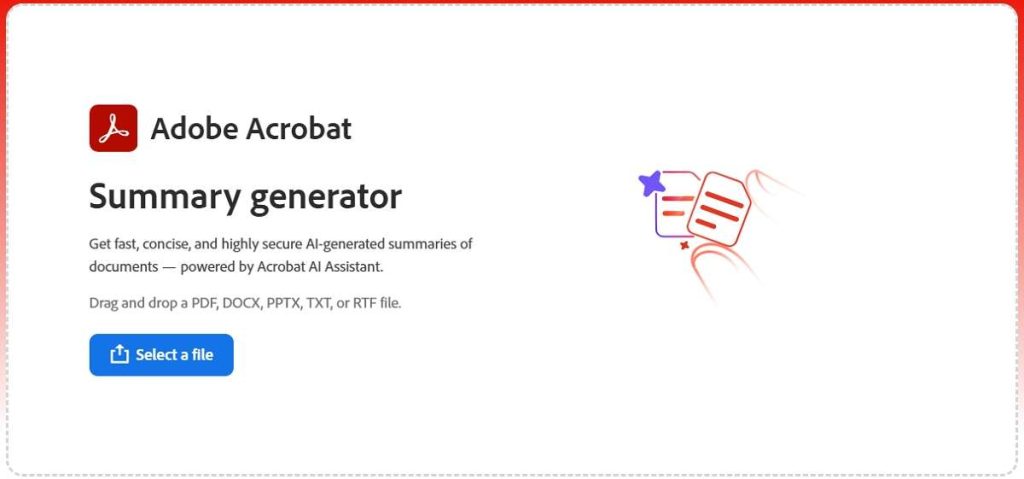
Supported Formats: PDF (native integration).
Key Features:
- Direct integration within Adobe Acrobat and the online reader
- Generates a summary alongside key points extracted from the document
- Offers citation suggestions for the generated summary
- Enterprise-grade security and compliance, crucial for business and legal documents
Pros & Cons:
Pros: Unmatched PDF integration; high trust and security from a established brand; excellent for business environments.
Cons: Primarily limited to PDFs; requires an Adobe subscription (not part of the free base plan) for full access.
User Comment: “Finally, a summary feature that works where my documents already live—in Acrobat. The seamless integration means I don’t have to upload sensitive contracts to a third-party site. For corporate and legal use, Adobe’s solution is the most trustworthy ai document summarizer available.“
5. EaseMate AI Document Summarizer
Brief Introduction: EaseMate takes an interactive approach to document summarization. While it creates a standard summary, its standout feature is the ability to “chat” with your document, allowing for a deep, conversational interrogation of the content.
Supported Formats: PDF, DOCX, PPTX, and TXT.
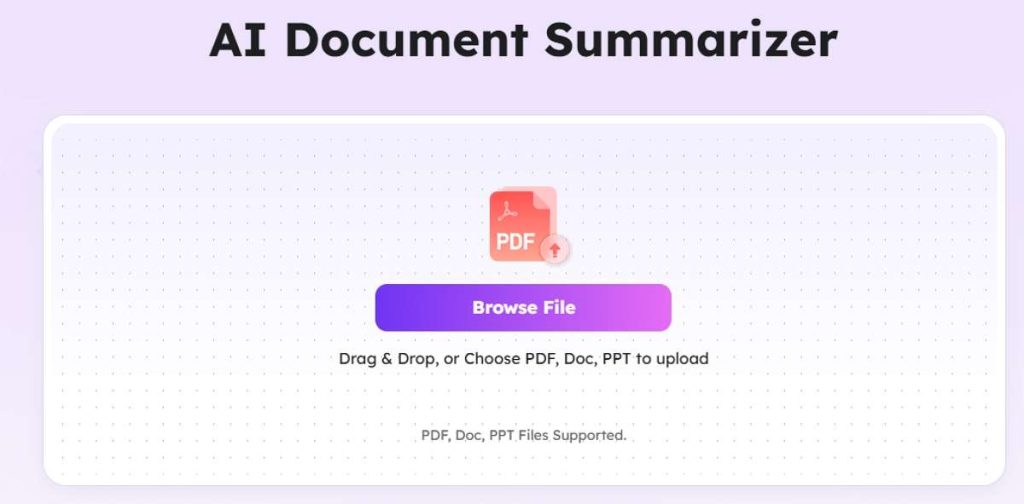
Key Features:
- AI summary generation upon upload
- Interactive chat interface to ask specific questions about the document’s content
- Ability to handle multiple documents in a single session for comparative analysis
- Generates potential questions you might want to ask about the document
Pros & Cons:
Pros: The chat feature is incredibly powerful for deep understanding; supports multi-document queries; intuitive question prompts.
Cons: The conversational approach can be slower than a simple one-click summary for straightforward tasks.
Expert Comment: “EaseMate is for the user who doesn’t just want a summary but wants to truly understand a document. The ability to ask follow-up questions and get instant, context-aware answers makes it less of a simple document summarizer ai and more of an interactive research assistant.“
Comparison Table of AI Summarizer
| Feature | Decopy AI | NoteGPT | Noiz AI | Adobe Acrobat | EaseMate |
|---|---|---|---|---|---|
| Best For | Speed & Daily Use | Academics & Research | Quick, Free Summaries | Business & PDF Workflows | Deep Document Interaction |
| Free Tier | Generous Free Plan | Limited Free Plan | 100% Free | Paid Subscription | Freemium Model |
| Key Feature | Browser Extension | Video Summarization | No Registration Required | Native PDF Integration | Chat with Document |
| Supported Formats | PDF, DOCX, PPTX, TXT | PDF, DOCX, TXT, Video | PDF, DOCX, TXT | PDF (Native) | PDF, DOCX, PPTX, TXT |
| Interface | Minimalist & Fast | Feature-Rich | Ultra-Simple | Integrated & Familiar | Interactive & Chat-Based |
| Ideal User | Marketers, Analysts | Students, Researchers | Casual Users, Journalists | Enterprises, Legal Teams | Consultants, Analysts |
FAQs About AI Document Summarizer
Q1: How accurate are AI document summarizers?
Modern AI summarizers are highly accurate in identifying main ideas and key points. However, they are not infallible. It’s always recommended to quickly scan the original text for critical details, especially with legal or technical documents where nuance is paramount.
Q2: Is my data safe when using a free ai document summarizer?
You must review the privacy policy of each tool. Reputable tools like Noiz process data anonymously, while others like Adobe prioritize enterprise-grade security. Avoid uploading highly sensitive documents to unfamiliar platforms.
Q3: Can an ai document summarizer handle technical or scientific papers?
Yes, most advanced tools are trained on diverse datasets, including academic text. Tools like NoteGPT and EaseMate, with their Q&A features, are particularly adept at helping you navigate complex, technical language. Since many documents are shared as PDFs, you may also find our guide to AI tools that summarize PDF files particularly useful.
Q4: What’s the average length of a generated summary?
This is typically customizable. Most tools allow you to select a summary length as a percentage of the original text (e.g., 10%, 25%, 50%) or choose between formats like bullet points (shorter) and a paragraph (more detailed).
Q5: Do these tools work in languages other than English?
Support varies. Many leading tools are primarily optimized for English but are increasingly adding multilingual capabilities. Always check the specific tool’s documentation for supported languages.
Final Words
The landscape of AI-powered document analysis is evolving at a breathtaking pace. Investing in a robust ai document summarizer is no longer a forward-thinking move but a practical step towards unparalleled productivity. Whether your priority is the no-cost simplicity of Noiz, the integrated power of Adobe, the research prowess of NoteGPT, the speed of Decopy, or the interactive depth of EaseMate, there is a perfect tool waiting to transform how you consume information.
The hours you save can be redirected to strategic thinking, creative endeavors, or simply achieving a better work-life balance. Streamline your document review process with these powerful tools. They are a key part of a larger ecosystem of AI tools designed to improve efficiency, which you can explore in our main article on AI summarizers for productivity.
We’d love to hear from you! Have you tried any of these tools? What has your experience been with using AI to summarize documents? Share your thoughts and favorite tools in the comments below.
 English
Darius Bacani
I love how accurate the summaries are with the PDF Summarizer of Undetectable.ai—it really captures the main points without missing important details.